Bio Resonance Scan Near Me
How Remote Sessions Work
If you have typed bio resonance scan near me into a search engine, you are probably assuming that you, the practitioner and the equipment all need to be in the same room. For most appointments that is a fair assumption. For frequency-based wellness work, practitioners say it is not always necessary. Understanding why distance matters less than you might expect can widen your options considerably, especially if the nearest clinic is an hour or more away.
What a Bio Resonance Scan Near Me Search Usually Means
Most people searching locally are not really hunting for a postcode. They are looking for something narrower: a practitioner they can trust, a session that fits around work or family life, and a journey they can manage. Proximity is a shortcut for all three.
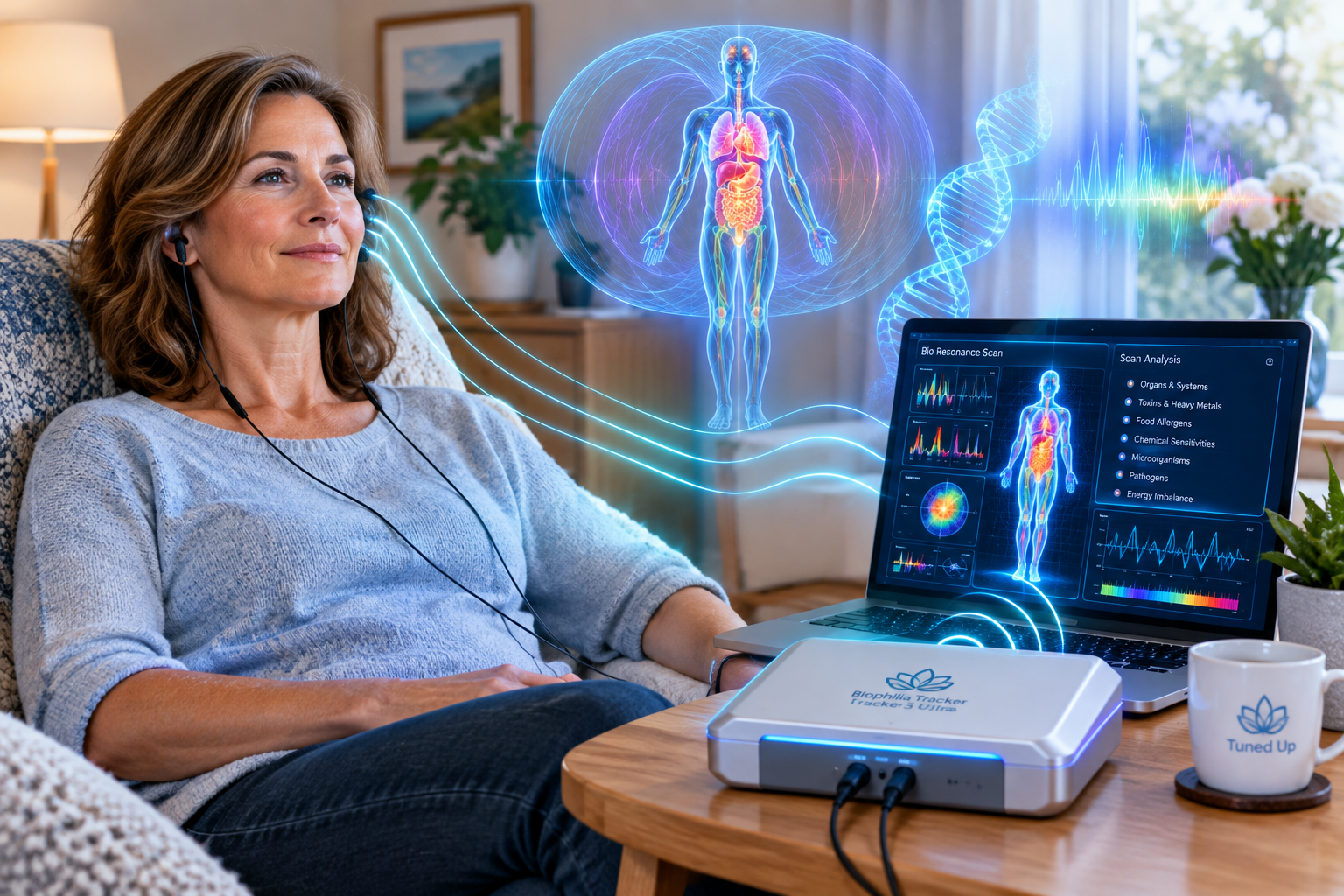
It helps to know that bioresonance practitioners are spread thinly across the UK. Clinics offering bioresonance testing and therapy operate in places such as Oxford, Leicester, Belfast and Walsall, and people routinely travel between towns and counties to reach them. If your nearest practitioner is an hour away, you are not doing anything unusual. You are working within a small field.
That is the point at which the remote question stops being philosophical and becomes practical.
The Working Principle Behind Bioresonance
Bioresonance developed in Germany in the 1970s. The idea behind it is that every cell, tissue and organ in the body produces its own electromagnetic signals, and that those signals can be read and, in some approaches, worked with to support the body’s own balancing processes. Practitioners describe it as a gentle, non-invasive technique. A bioresonance test involves no needles, no radiation and no discomfort.
Some systems go further. A full body scan of this kind is often described as having the ability to check, find, analyse and treat dysfunction produced at any time of your life. That is a large claim, and it sits firmly inside the wellness model rather than mainstream medicine.
What matters for this article is simpler. The whole approach rests on frequency and information rather than physical contact. Nothing about the technique requires a hand on your shoulder or a probe pressed against your skin in the way that a massage or a chiropractic adjustment does.
Why Frequency Does Not Stop at a Postcode
One clinic sets out the underlying idea neatly. The Earth itself resonates at a fundamental frequency of 7.83 Hz, known as the Schumann Resonance, a vibration described as essential for all forms of life. In the same way, the thinking goes, your own cells carry individual frequencies that help to keep you balanced.
If you accept that model, even provisionally, the geography question answers itself. A frequency is not a parcel. It does not have to be couriered from one building to another. Practitioners who work remotely are not trying to transmit anything across the miles. They are working with the information the body is already expressing, wherever that body happens to be sitting.
The Quantum Field Explanation, Held Honestly
Practitioners who offer remote sessions often reach for a particular way of describing this. They talk about a field that sits beneath physical matter, sometimes called the quantum field, in which everything is connected and distance is not the limiting factor it appears to be. Within that frame, a session is a meeting of intention and resonance rather than a physical procedure carried out at close range.
The status of that explanation deserves care. It is a model used within complementary wellness, not an established medical mechanism, and you do not have to accept it in full to find a session useful. Many people hold it loosely. They treat the appointment as a structured, reflective check-in on their wellbeing, and they judge it on how they feel afterwards rather than on the physics.
You can do the same. Curiosity and a willingness to engage are more useful than certainty.
What a Remote Bioresonance Session Actually Looks Like
What You Need at Your End
Very little. A quiet room, a reliable phone or internet connection, and enough time not to be rushing. A glass of water nearby is sensible. Some people prefer to sit comfortably with their feet flat on the floor, while others like to lie down. There is nothing physical to prepare, no fasting, no stopping medication and no special clothing.
What Happens at the Practitioner’s End
The practitioner works from their own space using the same equipment they would use for an in-person appointment. They run the session, note what the scan shows within their system, and then talk you through it. The conversation is the important part. A good practitioner explains what they have found, what it might relate to in your day-to-day life, and what they suggest you focus on next.
What Changes and What Stays the Same
What changes is the travel, the waiting room and the practical hassle of getting somewhere. What stays the same is the practitioner, the device, the length of the session and, in most cases, the shape of the conversation. Some practitioners find remote sessions slightly slower paced because body language is harder to read on a screen, although plenty of clients find them more relaxing for exactly that reason.
Where Local Still Matters: Tuned Up in Herne Bay
Tuned Up is a small, sole-trader wellness practice based in Herne Bay, run by Lee and operating on an appointment-only basis. It brings together three strands: bio-resonance wellness scanning, tuning fork sound therapy using solfeggio frequencies, and health coaching.
That mix matters here. Health coaching at Tuned Up is already offered in person or by Zoom, roughly biweekly, which means working at a distance is a normal part of how the practice runs rather than an afterthought. Sound therapy with tuning forks is naturally a hands-on, in-the-room experience. Bio-resonance scanning sits somewhere in the middle, and it is well worth asking directly what can be done remotely and what is better saved for a visit.
If you live in or around Herne Bay, the local option is straightforward. If you are further afield, the useful question is not whether you can get there, but which parts of the work genuinely need you in the room.
Questions to Ask Before You Book a Remote Session
A short conversation before booking will tell you a great deal about whether a practitioner is right for you.
Which device or system do you use, and how long have you been working with it?
Do you hold relevant certifications? Some practitioners list BICOM certification, REGUMED certification, or membership of bodies such as the Complementary Medical Association, and some work with German Rayoscan technology.
What exactly does a remote session include, and how long does it last?
How will you explain your findings, and in how much detail?
What follow-up do you suggest, and is any of it included?
What are the limits of what you can help with?
That last question is the most revealing one. A practitioner who answers it clearly is worth more than one who promises everything.
Keeping Expectations Realistic
Bioresonance is a complementary approach that some people use for wellbeing support. It does not diagnose illness or disease, it is not a substitute for medical care, and if you have symptoms that concern you, your GP is the right first port of call. The same applies whether you attend in person or work remotely.
What remote sessions offer is access. If the nearest practitioner is far away, or if travel is difficult because of pain, fatigue or a busy household, distance stops being the deciding factor. That alone changes the answer to the question you started with.
Frequently Asked Questions
Can a bioresonance scan really be done remotely?
Practitioners who work this way say yes, because the technique is based on reading frequency information rather than on physical contact. Nothing in the method requires the device to touch you. You need a quiet space and a phone or internet connection. What you cannot do remotely is the hands-on side of a practice, such as tuning fork sound therapy, so expect a mix if you book both.
How do I choose a practitioner if I am not visiting in person?
Ask about training, equipment and certification before you book. Some practitioners list BICOM certification, REGUMED certification, or membership of bodies such as the Complementary Medical Association, and some work with German Rayoscan technology. Ask how findings are explained, how long a session runs, and what follow-up is included. Someone who answers plainly and admits the limits of what they offer is usually a better bet than someone who promises everything.
Does bioresonance work through the quantum field?
That is how many practitioners describe it, but treat it as a model rather than settled science. The idea is that everything is connected at a level beneath physical matter, so distance stops being a barrier. Mainstream medicine does not use bioresonance to diagnose or treat illness. You can engage with a session as a wellbeing check-in, judging it on how you feel, without resolving the physics.
Is bioresonance a replacement for medical care?
No. Bioresonance is a complementary approach that some people use for wellbeing support. It does not diagnose illness or disease, and it should not delay you seeking proper medical advice. If you have symptoms that worry you, speak to your GP first. You can still use bioresonance alongside conventional care, and many people do, but it sits beside medical treatment rather than replacing it.